How to Play Ayo: The Yoruba Mancala Game, Step by Step
Twelve holes, 48 seeds and a lot of trash talk. Here's how to play Ayo properly, from setup to your first win.
7 min read

The sound comes first. A soft, steady click-click-click of seeds dropping into wooden holes, followed by a sudden shout because somebody just scooped half the board. If you grew up around a Yoruba compound, a barbershop or a quiet afternoon under a mango tree, you know that sound. That's Ayo.
If you didn't grow up with it, you're in for a treat. Learning how to play Ayo takes about ten minutes. Getting good at it takes years, and that gap is exactly why people have played it for generations.
This guide walks you through the board, the setup, a full turn and how the game ends, then gives you strategy so you don't get embarrassed by your uncle on your first try.
What is Ayo?
Ayo (in full, Ayò Ọlọ́pọ́n) is a traditional board game of the Yoruba people of southwest Nigeria. It belongs to the mancala family, a huge group of "count and capture" games played across Africa, the Middle East, Asia and the Caribbean. Its close cousin is Oware, widely played in Ghana and across West Africa, and the two share the same board and the same starting setup.
The idea is simple: you move seeds around a board, and you try to capture more seeds than your opponent. There are no dice, no hidden cards and no luck. Every move is in plain sight. That's what makes losing at Ayo so personal.
What you need to play Ayo
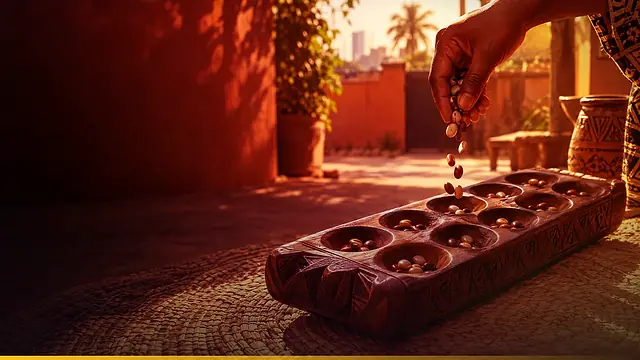
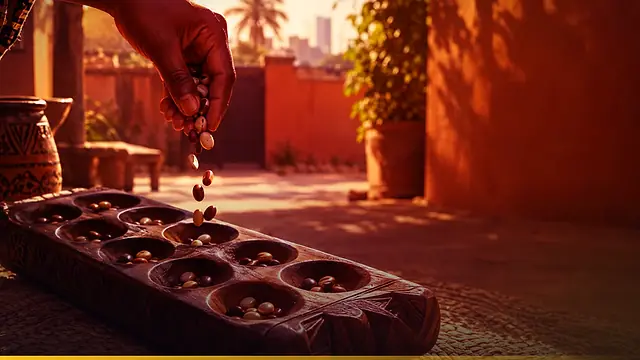
- A board with two rows of six holes. Traditional boards are carved wood, often beautifully decorated. In a pinch, two rows of six cups, egg-carton halves or holes scooped into sand work fine.
- 48 seeds. Traditionally these are dried seeds from a particular plant, but pebbles, beads, buttons or dried beans all work.
- Two players sitting on opposite sides of the board.
Each player owns the row of six holes closest to them.
How to play Ayo: step by step
The rules below follow the version of Ayo documented on Wikipedia's Ayoayo page. Expect local variations, because families and towns often play slightly differently. More on that later.
Step 1: Set up the board
Put 4 seeds in each of the 12 holes. That's 24 seeds per side and 48 in total. Decide who goes first. A coin toss works, or the classic method: the younger player goes first and the older player pretends they're being generous.
Step 2: Pick up and sow
On your turn, choose one hole on your side that has seeds in it. Pick up all the seeds from that hole. Then, moving counterclockwise, drop one seed into each hole that follows: first along your row, then around into your opponent's row, and so on.
This dropping-one-at-a-time move is called sowing.
Step 3: Skip the starting hole
If you're sowing a big pile (twelve or more seeds), you'll go all the way around the board. When you reach the hole you started from, skip it. No seed goes back into the hole you emptied.
Step 4: Relay sowing
Ayo uses what's called relay sowing. In the way it's commonly played, if your last seed lands in a hole that already has seeds, you pick up everything in that hole and keep sowing from there. Your move carries on like a relay race, hole to hole, until your last seed drops into an empty hole. That's when your turn ends.
This is the part that makes Ayo feel alive. One move can snake around the board several times and completely rearrange it.
Step 5: Capture
When your last seed lands in an empty hole on your own side, you capture all the seeds sitting in your opponent's hole directly opposite. Take them off the board and put them in your store (a pile beside you, or the carved bowls at the ends of a fancy board).
If your last seed lands in an empty hole on your opponent's side, nothing is captured. Your turn just ends.
Step 6: Feed your opponent
Here's the sporting rule. If your opponent ends up with no seeds at all in their row, you must, if any move allows it, make a move that puts at least one seed back into their row. This is often called "feeding". You can't simply starve someone out when you have a choice.
Step 7: End the game
The game ends when a player can't make a move. At that point, the other player collects all the seeds still left on the board. Everyone counts their captured seeds, and whoever has more wins. With 48 seeds in play, 25 or more is a guaranteed victory.
Common house rules and variations
Ask three Ayo players for the rules and you might get four answers. That's normal for a game passed down by hand rather than printed in a rulebook. Some common differences:
- Oware-style captures. Many players across West Africa use the Oware capture: if your last seed lands in an opponent's hole and makes the count exactly two or three, you take those seeds, plus any unbroken run of twos and threes in the holes just before it.
- No relay. Some play single-lap sowing, where your turn simply ends where your last seed lands.
- Ending early. When only a few seeds circle endlessly, players often agree to stop and each keep the seeds on their own side.
Our advice: agree on the rules before the first seed moves. A thirty-second chat prevents a thirty-minute argument. Write them on a scrap of paper if you're playing for bragging rights.
In Ayo, the rules are the easy part. Reading your opponent is the real game.
Beginner Ayo strategy that actually helps
Once you know the moves, these habits will win you more games.
Count before you pick up
Experienced players don't guess. Before choosing a hole, they count where the last seed will land. With relay sowing this gets tricky, so start by counting just the first lap. You'll be surprised how often a "random" move hands your opponent a capture.
Watch the empty holes
Empty holes on your side are capture opportunities for you. Empty holes on your opponent's side are danger zones for them. Look at what's sitting opposite every empty hole. Big pile opposite your empty hole? That's a target. Big pile on your side opposite their empty hole? Protect it.
Build a heavy hole
Many good players quietly let one hole on their side grow large. A big pile gives you a long, unpredictable move later, one that can loop the board and land exactly where you want. Just don't let it sit opposite one of your opponent's empty holes.
Keep options open
Having seeds in several holes gives you choices. If your seeds are bunched into one or two holes, you'll soon be forced into moves you don't like.
Think one move ahead for them
After you plan your move, ask: "What's the best thing my opponent can do next?" If the answer is "capture eight seeds", pick something else.
Play many short games
The fastest way to improve is volume. Play quick games, lose often, and pay attention to how you lost. Ayo rewards pattern recognition, and patterns only come from repetition.
Why Ayo is worth learning (even if you're not Yoruba)
Ayo is more than a pastime. It's maths you can feel in your hands, and it's a social game at heart: people gather to watch, comment and argue about what the player should have done. Teaching it to a friend is an easy way to share a bit of culture, and playing it with an elder is a lovely way to bridge generations.
If you love it, you might also enjoy exploring other games from the continent. Our guide to African board games covers Bao, Morabaraba, Senet and more, and our post on Nigerian childhood playground games is a nostalgia trip worth taking. For more on keeping culture alive far from home, browse our culture and diaspora hub.
Play Ayo online with friends
No wooden board? No wahala. Ayo is one of the games on Kindred, alongside Ludo, trivia and street-life racers like Danfo Run. You can play solo, or open a live multiplayer room and play with a friend on another device, which is handy if your favourite opponent lives in another city or another country. See how Kindred works if you're curious.
Your Ayo challenge
Find a board, or make one from an egg carton and 48 beans. Teach someone this week. Explain the setup, play one slow game where you both count out loud, then play a fast one. Afterwards, ask them one question: "Which move did you regret?"
That conversation is where the real fun starts. And if they beat you on the first try? Smile, reset the seeds and say the words every Ayo player knows by heart: "Again."