African Board Games: Mancala, Morabaraba and More
Some of the oldest board games on earth come from Africa, and many are still played on streets and in sand today. Here's your tour.
6 min read

Some of the oldest board games humans have ever played were born in Africa. Thousands of years ago, Egyptians were burying game boards with their dead. Today, in a barbershop in Ibadan, a market in Kumasi or a shaded corner in Zanzibar, people are still scooping seeds into carved holes and shouting about captures. Same spirit, different century.
African board games aren't museum pieces. Many are alive, competitive and surprisingly deep, with tournaments, legendary masters and rules that vary from village to village. This guide is a friendly tour of the big ones: what they are, where they're played and how they work in a nutshell.
The mancala family: count and capture
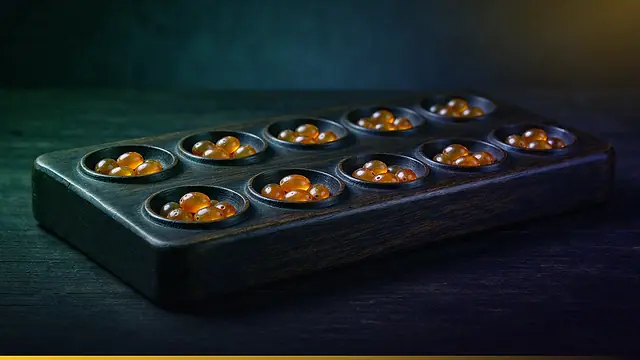
If you know just one family of African board games, make it mancala. Mancala isn't one game. It's a huge family of "sowing" games, played across Africa and far beyond, where you pick up seeds from a hole and drop them one by one into the following holes, trying to capture more seeds than your opponent.
The board can be carved wood, a row of cups or holes scooped in the ground. The seeds can be seeds, pebbles, shells or beans. That flexibility is part of why mancala games spread so widely. You can play anywhere.
Ayo (Nigeria)
Ayo, or Ayò Ọlọ́pọ́n, is the Yoruba mancala game from southwest Nigeria. It uses a board of two rows of six holes, with 48 seeds, four per hole at the start. Players sow counterclockwise, and the documented version uses relay sowing, where a move can keep going around the board. Ayo is deeply social: there are always spectators, and they always have opinions.
We have a complete step-by-step guide on how to play Ayo if you want to learn properly.
Oware (Ghana and West Africa)
Oware is Ayo's close cousin, especially associated with the Akan people of Ghana and widely played across West Africa and the Caribbean. Same board, same 48 seeds. In the most common version, you capture when your last seed lands in an opponent's hole and makes a total of two or three, and you can keep capturing backwards along a run of twos and threes.
Oware has many names (Warri, Awale, Awari) and many local rule variations, which is why arguments about "the real rules" are a cherished tradition.
Bao (East Africa)
Bao is the heavyweight of the mancala world. Played across East Africa and especially loved by Swahili communities in Tanzania and Kenya, it uses a board of four rows of eight pits, with each player controlling two rows. The board even has a special square pit called the nyumba (house).
Bao is known for its complexity and strategic depth, and in places like Zanzibar, a Bao master is held in high respect. The Swahili word "bao" simply means "board" or "board game". If Ayo is draughts, Bao is closer to chess.
Morabaraba: the cattle game of Southern Africa
Morabaraba is a strategy game played mainly in South Africa and Botswana, with a variant in Lesotho. Each player has 12 pieces called "cows". The board is a grid of intersections connected by lines, simple enough to scratch into stone or draw in the sand, which is exactly how many herders played it.
The aim is to form a mill, three of your cows in a line. Every time you make a mill, you remove one of your opponent's cows. When a player is down to three cows, those cows can "fly" to any empty point, giving the losing side a desperate last chance.
If that sounds familiar, it's because Morabaraba is a relative of the European game Nine Men's Morris. In South Africa, Morabaraba is taken seriously enough to have organised competitive play.
Every one of these games can be played with a stick, some sand and a handful of stones. That's what makes them timeless.
Fanorona: Madagascar's mind-bender
Fanorona comes from Madagascar, and it's unlike almost any other board game. The most popular version, Fanoron-Sivy, is played on a grid of five rows and nine columns, with diagonal lines connecting some points. Each player has 22 stones, filling the whole board except the centre.
The magic is in how you capture:
- Approach: move a stone towards an enemy stone so it lands right next to it, and you capture it, plus any enemy stones lined up behind it.
- Withdrawal: move a stone directly away from an adjacent enemy stone, and you capture that stone and the line behind it.
Captures can chain together, making single moves wildly dramatic. There's also a famous legend in Madagascar about a king choosing his successor partly based on Fanorona, which tells you how seriously the game has been taken.
Yoté: fast and fierce in West Africa
Yoté is a traditional West African strategy game known for being quick, which made it popular for friendly bets. It's played on a 5 by 6 board. Each player starts with 12 pieces in hand, and on each turn you either place a new piece on an empty square or move one already on the board a single step.
You capture by jumping over an adjacent enemy piece, and here's the twist: after each capture, you also remove one extra enemy piece of your choice from anywhere on the board. Captures swing the game fast, so keeping pieces in hand as reserves is a big part of strategy.
Senet: the ancient Egyptian classic
No tour of African board games is complete without Senet, one of the oldest known board games in the world. It was played in ancient Egypt for around two thousand years, and boards have been found in tombs, including Tutankhamun's.
The board has 30 squares in three rows of ten. Here's the fun part: nobody knows the original rules for certain. Modern rules are reconstructions by historians based on fragmentary evidence. Over time, Senet also took on religious meaning, linked to the soul's journey through the afterlife.
You can buy modern Senet sets with reconstructed rules, and playing one feels like holding a piece of history in your hands.
Why these games still matter
These games are more than entertainment. They're living culture. They carry maths, logic and strategy in a form children can learn in the dust, and adults can spend a lifetime mastering. They connect generations, because grandparents often know the old rules and grandchildren bring new energy.
For people in the diaspora, teaching a child Ayo or Oware is a beautiful way to pass on a bit of home. For everyone else, they're a reminder that great game design didn't start with expensive boxed sets.
If you love this kind of nostalgia, our post on Nigerian childhood playground games is a fun companion read, and the culture and diaspora hub has more on keeping traditions alive abroad.
How to start playing African board games
- Start with mancala. Ayo or Oware are the easiest entry points and the most widely played.
- Make your own board. An egg carton and 48 beans make a perfectly good Ayo or Oware set. Morabaraba and Yoté can be drawn on paper.
- Look for local players. Cultural centres, African community groups and some board game cafés host games and meetups.
- Agree on rules first. These games have many variants. A quick chat before playing saves a long argument after.
- Play online. Kindred's Games pillar includes Ayo and Ludo, playable solo or in live multiplayer rooms with friends across devices, alongside trivia and street-life games like Danfo Run. Communities on Kindred also let you join small groups around shared interests, including games. See how Kindred works.
Your board game challenge
Pick one game from this list that you've never played. Make the board yourself this weekend, from cardboard, an egg carton or chalk on the floor. Then teach it to one person.
When they ask where it comes from, tell them the story. That's how these games have survived for centuries: one patient teacher, one curious player and a handful of seeds.