Whot Card Game Rules and Strategy for Beginners
Hold on, pick two, general market. If those words mean nothing to you yet, this is your crash course in Whot, plus the tactics to win.
6 min read

Confession time, and be honest: have you ever lost at Whot to a child? Picture it. You sit down at a family gathering, confident, an adult with a job and a pension plan, and lose five rounds in a row to your twelve-year-old cousin. She doesn't just beat you. She narrates it. "General market," she says, sliding a 14 onto the pile with the calm of a bank manager, while you draw yet another card and quietly reconsider your life choices.
If you've never played, Whot looks simple. Match the shape or number, get rid of your cards, done. Then someone drops a Pick Two, someone else defends with another Pick Two, and suddenly you're holding eleven cards and wondering how it went wrong. This guide covers the Whot card game rules properly, the special cards and the strategy that separates casual players from the cousin everyone avoids at Christmas.
A quick history of Whot
Here's the plot twist many Nigerians don't know: Whot was invented in England. According to its Wikipedia entry, it was created by William Henry Storey and trademarked in 1935, and it was popular in Britain in the mid-twentieth century. But it found its true home in West Africa, where the Nigerian version, with its own special-card rules, has been described as the country's national card game.
So if a British friend says "Oh, I think my gran used to play that," you can nod and say, "Yes, and then we perfected it."
The Whot deck explained
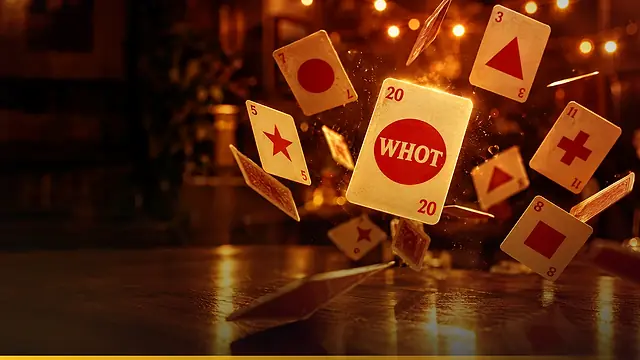
A standard Whot deck has 54 cards in five suits (shapes):
- Circles
- Triangles
- Crosses
- Squares
- Stars
Each suit is numbered from 1 up to 14, but not every number appears in every suit, which is part of what makes the game less predictable than a regular deck. On top of that, there are five Whot cards numbered 20. These are the wild cards, and they're the most powerful cards in your hand.
Basic Whot card game rules
The core rules are easy. It's the special cards that add the spice.
Setting up
- Shuffle and deal each player a hand. Many Nigerian games use five or six cards each, though the number is agreed by the players. Agree before dealing.
- Place the rest of the deck face down as the market (the draw pile).
- Turn the top card face up to start the discard pile. This is the call card.
Taking a turn
On your turn you must do one of these:
- Play a card that matches the call card's shape or number. A 7 of circles can be followed by any circle or any 7.
- Play a Whot card (20). It can go on anything, and you then name the shape the next player must play.
- Go to market. If you can't or won't play, draw one card from the market. That ends your turn.
You can't simply pass. If you don't play, you draw.
Winning
The first player to get rid of all their cards wins the round. Traditionally, players announce when they're down to their last card. In many groups you must say "last card" out loud, and if you forget, you draw a penalty card. Some groups also shout "check up" when they play their final card. Agree on these calls at the start.
The special cards in Nigerian Whot
This is where it gets interesting. Under the Nigerian rules:
- 1: Hold On. Everyone else is held, and you play again. Brilliant for chaining your cards.
- 2: Pick Two. The next player must draw two cards from the market, unless they defend by playing their own 2. Defences stack, so the penalty passes along to whoever can't defend.
- 5: Pick Three. Same idea as Pick Two, but three cards. Defend with another 5.
- 8: Suspension. The next player misses their turn.
- 14: General Market. Every other player draws one card from the market, and you play again.
- 20: Whot. The wild card. Play it on anything and request the shape you want next.
House rules vary wildly here. Some groups let you defend a Pick Two with a Pick Three. Some don't allow ending the game on a special card. Some allow a Whot card to be played to dodge a pick penalty. None of these are wrong, but all of them cause fights if they're not agreed first.
The most important Whot rule isn't in any rulebook: settle the house rules before you deal.
Scoring across several rounds
If you're playing a longer session, you can keep score. A common method: when someone wins a round, everyone else adds up the numbers on the cards still in their hand. For star cards, count the number shown on the card. Lowest running total at the end wins, or players drop out once they hit an agreed limit, such as 100.
Scoring changes how people play. Suddenly that 14 sitting in your hand is a liability as well as a weapon.
Whot strategy: how to stop losing
Whot has luck in it, but good players win far more often than bad ones. Here's why.
Hold your Whot card
New players drop the Whot card early because it feels powerful. Resist. A Whot card is your emergency exit: when you're stuck with no matching shape, it saves you from market. It's often best saved for your last few cards, when you can request the exact shape you're holding.
Keep a defence ready
If you have a 2 or a 5, think twice before throwing it away casually. It's your shield against incoming picks. Being able to bounce a Pick Two back at someone feels fantastic.
Count the shapes
Watch what's been played. If you've seen loads of triangles go down, triangles are getting rare, so requesting triangles with a Whot card might force others to market. Even rough counting gives you an edge.
Use Hold On and General Market to chain
A 1 or a 14 lets you play again. Line up a sequence: General Market, then Hold On, then your final matching card. Done right, you can go from three cards to zero while everyone else is drawing.
Watch the player on your left
The person after you is the one most affected by your Pick Twos and Suspensions. If they're close to winning, hit them. If they're loaded with cards, you can relax and play your low cards instead.
Change shapes to suit yourself
When you play a card, think about what shape you're leaving for the next player. If you have lots of circles, try to keep the call card on circles. If someone has just requested squares because they're holding squares, switch the shape as soon as you can.
Don't forget to announce
It sounds silly, but losing because you forgot to say "last card" is painful. Make it a habit.
Mind your Whot etiquette (yes, it matters)
Whot is famously loud. Trash talk is part of the culture, and dramatic card slaps are practically compulsory. But a few manners keep it fun:
- Don't hide cards under your leg. Everyone knows that trick.
- Don't take forever on your turn.
- Be gracious when you win. Mostly.
- If you're teaching a newcomer, give them a "free practice round" before keeping score.
Where Whot fits on game night
Whot is perfect for three to six players and works everywhere: at a family gathering, on a long journey, during a power cut with a torch. If you want a whole evening of variety, mix it with other easy games from our list of card games to play with friends or turn the night into a mini tournament with Ludo (here's our Ludo strategy guide).
Hosting a gathering this season? Our events and hangouts hub is full of ideas for nights where people actually talk to each other.
And if your favourite opponents are scattered across cities, Kindred has a Games pillar with Ludo, Ayo, trivia and more, playable solo or live with friends across devices. It's a good way to keep the competitive banter going between visits. You can read how it works here.
Your Whot challenge
Buy a deck (or dig out the one in your mum's drawer), gather three people and play best of five. Before the first deal, write down your house rules: what defends a Pick Two, whether you can finish on a special card, what you shout at the end.
Then hold your Whot card longer than feels comfortable. Trust the process. Somewhere out there, a twelve-year-old is already doing it.